

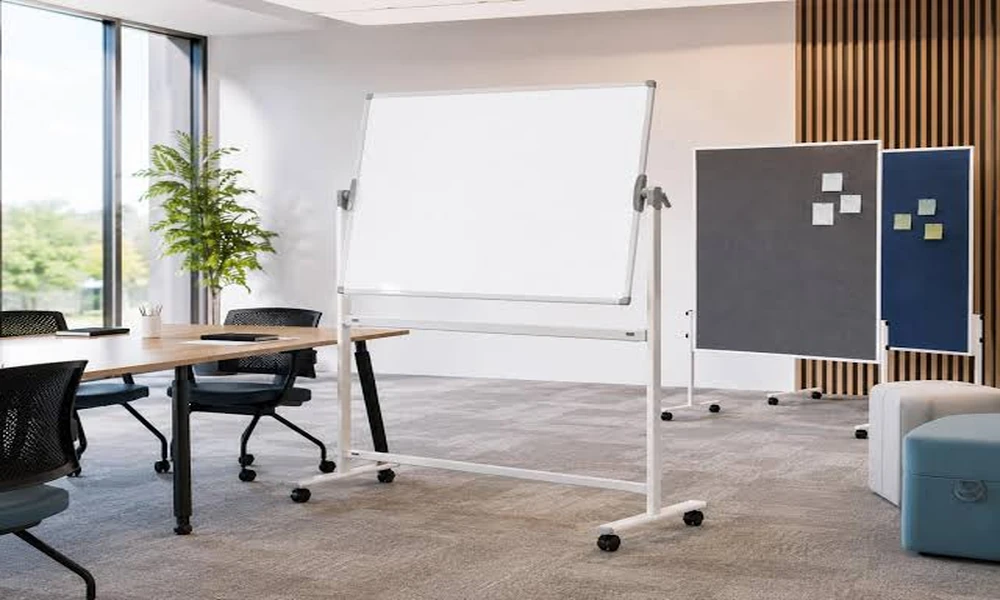
Mobile whiteboards support flexible learning spaces by bringing a writing surface to wherever students gather, rather than fixing instruction to a single wall. As classrooms shift toward group work, project-based learning, and reconfigurable furniture, mobile boards give teachers and students a portable tool for collaboration.
U.S. public schools employ roughly 3.2 million full-time-equivalent teachers (National Center for Education Statistics).
What is a mobile whiteboard?
A mobile whiteboard is a writing surface mounted on a wheeled frame that can be moved around a room or between rooms. Double-sided models are common, and some offer a writing surface on one side and a tackboard on the other.
Frames and casters
Mobile units are typically built with welded steel frames and casters that allow smooth movement. Locking casters hold the board in place during use.
How mobile units are built
Mobile units are built on welded steel framing with a baked enamel finish, with ball-type casters at each foot assembly for easier movement (ASI Visual Display Products).
Why are flexible learning spaces growing?
Flexible learning spaces are growing because educators increasingly use instructional approaches that require students to move, collaborate, and work in small groups. Rows of desks facing a single wall no longer fit every lesson.
Teaching approaches that benefit from flexibility
- Small-group instruction and learning centers
- Project-based and inquiry learning
- Peer collaboration and group problem-solving
- Station rotations
- Team teaching in shared spaces
Schools across the country have adapted classroom layouts to support more active instructional methods (U.S. Department of Education).
How do mobile boards improve collaboration?
Mobile boards improve collaboration by giving each group its own writing surface and by allowing teams to move their work to share it with the class. Students can brainstorm, solve problems, and present without competing for space on a single wall board.
Collaboration benefits
- Dedicated writing space for each group
- Easy movement to present work to the class
- Double-sided surfaces for more work area
- Temporary room dividers for group separation
- Portable display for posters and handouts
When a lesson ends, boards can be rolled aside or moved to another room, making them useful in shared spaces like libraries and media centers.
What construction features matter in mobile boards?
Construction features that matter in mobile boards include frame rigidity, caster quality, surface durability, and stability during use. A board that wobbles or tips is a safety concern and a distraction.
Features to evaluate
- Welded steel frames for rigidity
- Smooth-rolling casters with locks
- Wide base for stability
- Durable writing surfaces such as porcelain
- Reversible or double-sided panels
Where are mobile boards most useful?
Mobile boards are most useful in classrooms, libraries, maker spaces, conference rooms, and training centers where room layouts change frequently. They also serve schools with limited wall space or rooms with large windows.
Common locations
- Elementary and secondary classrooms
- Media centers and libraries
- STEM labs and maker spaces
- Corporate training rooms
- Healthcare education and conference rooms
Mobile units also help in temporary classrooms and during renovations, when fixed boards are unavailable.
How do mobile boards affect room safety and circulation?
Mobile boards affect room safety and circulation because they occupy floor space and can obstruct paths if placed carelessly. Planning where boards are used and stored keeps aisles clear.
Keeping routes clear
Accessible routes and clear floor space should stay open when boards are in use and when they are stored (U.S. Access Board). Keeping routes open when boards are in use and when they are stored supports safe movement for everyone in the room.
Safe use practices
- Lock casters during use
- Store boards along walls when not in use
- Keep boards out of exit paths
- Avoid leaning or climbing on units
- Inspect casters and frames regularly
How do surface choices affect mobile board performance?
Surface choices affect mobile board performance the same way they affect wall-mounted boards. Porcelain surfaces offer durability and ghosting resistance, while painted steel offers a lower-cost option.
Durable surfaces for group use
Because mobile boards are often used heavily by groups of students, durable surfaces help them hold up to frequent writing and erasing. Magnetic porcelain surfaces also let students post work during presentations.
How can mobile boards extend the value of existing classrooms?
Mobile boards extend the value of existing classrooms by adding writing area without renovation. A classroom with a single wall board can gain several additional writing surfaces simply by adding mobile units.
Flexibility without renovation
This approach is especially useful for schools that want to support new teaching methods but lack funding for large-scale renovations. Mobile boards deliver flexibility immediately.
How should schools maintain mobile boards?
Schools should maintain mobile boards by cleaning writing surfaces regularly, checking casters and locks, tightening hardware, and storing boards safely when not in use. Routine care keeps units stable and functional.
Maintenance checklist
- Clean surfaces with manufacturer-recommended products
- Inspect casters for wear and debris
- Tighten frame fasteners as needed
- Check locking mechanisms
- Store boards in designated locations
How do mobile boards support shared and multipurpose rooms?
Mobile boards support shared and multipurpose rooms by giving each user group its own writing surface that can be rolled in for a session and stored afterward. Libraries, cafeterias used for after-school programs, and community rooms benefit from boards that do not permanently occupy wall space.
Moving boards between programs
Schools that schedule tutoring, clubs, and professional development in the same rooms can move boards between spaces as needed. Assigning boards to specific rooms or programs and labeling them helps staff return units to the right location at the end of the day.
Why are mobile whiteboards a strong investment for schools?
Mobile whiteboards are a strong investment for schools because they support multiple teaching methods, serve several rooms, and adapt as instructional needs change. Their flexibility makes them useful long after a specific lesson plan or room layout changes. For educators building active, collaborative classrooms, mobile boards turn any open space into a place for learning.